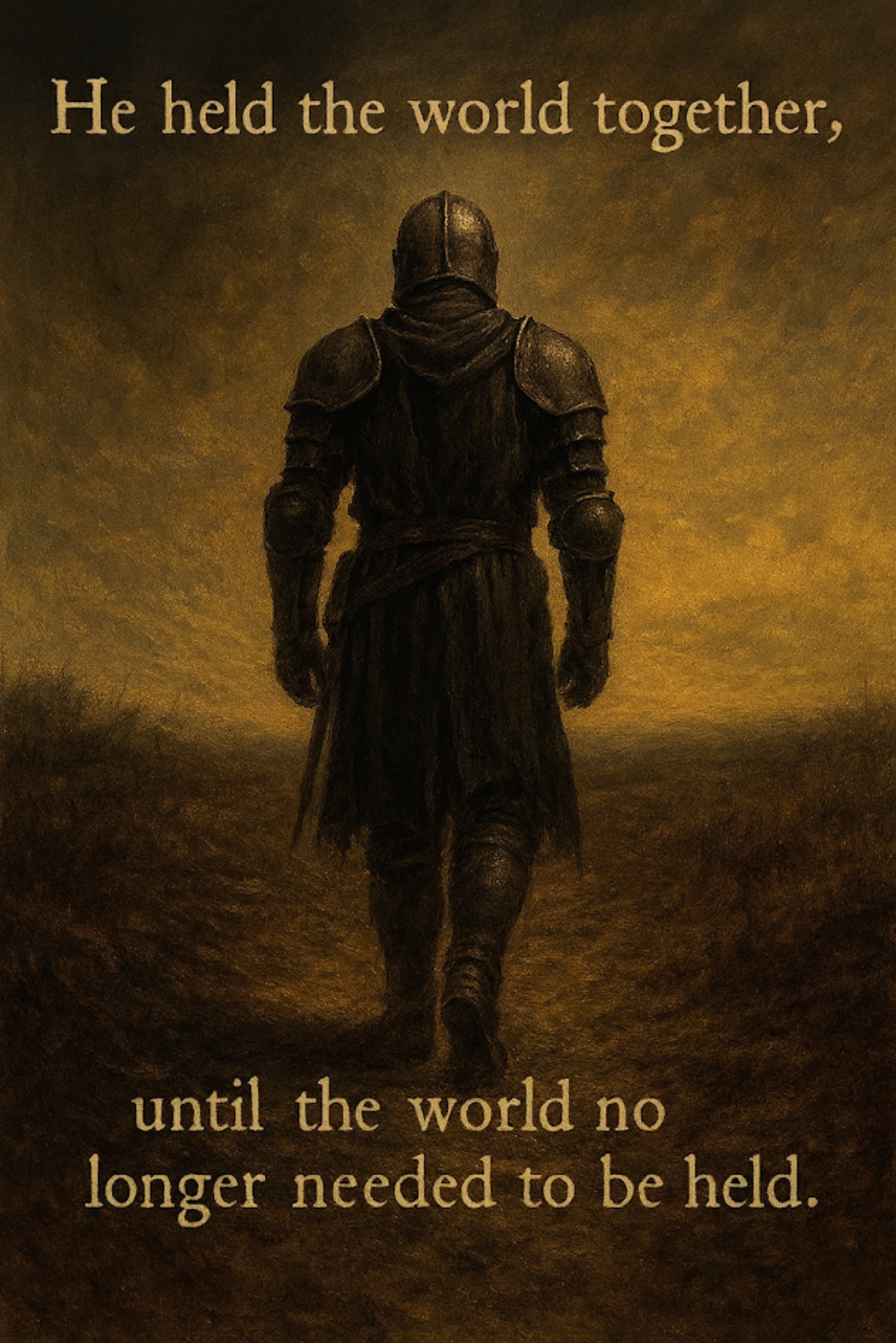
The Sentinel's Last March
Prologue: The Misunderstood Wound
There is a chapter of this story I misunderstood for years, so deeply that I carried its shame like a stone in my chest. It happened nearly two years before the awakening, long before I had language for rupture or reintegration, long before I understood the architecture of the selves inside me.
My wife had returned to school. Her days were long, her nights exhausting, and she was building something better for all of us through sheer determination. And she asked me for help. Not symbolic help. Real help: cooking, cleaning, towels, floors, groceries, the quiet labor that holds a family together.
She told me she would make schedules for me. Days for towels. Days for sweeping. Days for mopping. Small systems to help carry the home while she carried so much herself.
She never even made them.
But something inside me recoiled with a force I did not understand. I remember the panic. Not irritation, not resentment. Panic. And before I understood what was happening, the sentence escaped me:
“I can’t be you.”
At the time, it sounded cruel. Weak. Like refusal. Like the words of a man unwilling to rise for the woman who had stood beside him for twenty-five years.
For years, I believed I had failed her.
Now, with unbearable clarity, I understand what happened.
That was the Sentinel. Not refusing duty. Protecting the final boundary he believed he could still hold.
He had spent decades carrying a burden no child should inherit, holding together a fractured inner world through vigilance, endurance, and sacrifice. Standing watch through storms no one else could see. Somewhere inside himself, he understood something terrifying: if one more weight were added, something essential would break. Not dramatically. Quietly. The armor would fail, and the child beneath it would stand exposed.
So when he said, “I can’t be you,” what he meant was something closer to this:
I can’t be you.
I can barely be me.
Not because he lacked love, but because he had reached the outer edge of what one guardian could bear.
And even then, he remained at his post.
Chapter I: The Declaration
Nearly two years later, something finally surfaced.
It happened at the dinner table.
I had found year-round house lights online, something my wife had once mentioned wanting. I thought I was doing something thoughtful, something kind. But plans already existed. Expectations had already formed. My daughters had imagined something different.
The moment itself was ordinary, the kind of misunderstanding most families forget by morning.
But something inside me buckled. And before I understood where it came from, the sentence left my mouth:
“I don’t belong here.”
At the time, it felt dramatic. Embarrassing. Wrong.
Now I hear something else inside it.
Not rebellion. Not self-pity.
Recognition.
The Sentinel had stood watch for so long that somewhere along the road he had forgotten there might someday be room for him beyond the work. And in that moment, perhaps for the first time, something ancient inside him understood:
My time is over.
The Heir must take my place.
Chapter II: The Last March
No ceremony came for him. No applause. No great hall rising to its feet. No moment like the stories, where a room finally understands what survival required.
Like Harry quietly saying, “I’m just Harry,” the Sentinel never thought of himself as extraordinary. He was built for duty, not glory.
His task had always been painfully simple:
Keep the boy alive long enough to return.
And so he stood watch through fear, fracture, confusion, and decades of carrying more than one life should have to carry. No one relieved him. No hand touched his shoulder and said you’ve done enough. Yet still he carried the burden, not because he wanted praise, not because he mistook sacrifice for virtue, but because it was his duty.
And when the dawn finally came, he did what all faithful guardians must eventually do.
He stepped aside.
Quietly.
Without ceremony.
Without asking to be understood.
His march complete.
His watch fulfilled.
Chapter III: What Remains
And then something strange happened.
The ordinary things returned.
Today, I sweep. I mop. I wash towels. I pick up groceries. I help.
Not because someone demands it. Not because guilt finally won. Not because a schedule commands obedience.
But because the war is over.
The tasks did not change.
I did.
What once felt crushing now feels human. Even loving.
And every ordinary act carries a quiet truth:
The Sentinel succeeded.
The watch held.
The burden mattered.
The soldier remained standing long enough for someone steadier, more whole, to inherit the life he protected.
Chapter IV: Memorial
So let this stand in place of the recognition he never asked for.
A memorial, given late.
A soldier honored after the war.
The Sentinel never failed.
He endured.
He carried more than he should have, for longer than he should have, and still refused to abandon the life entrusted to him.
He did not save the world.
Only mine.
And perhaps that was always enough.
His march is over.
His watch complete.
His burden finally laid down.
And if no one else can honor the life he spent protecting mine,
then I will.
His eulogy is simple:
"He held the world together, until the world no longer needed to be held."